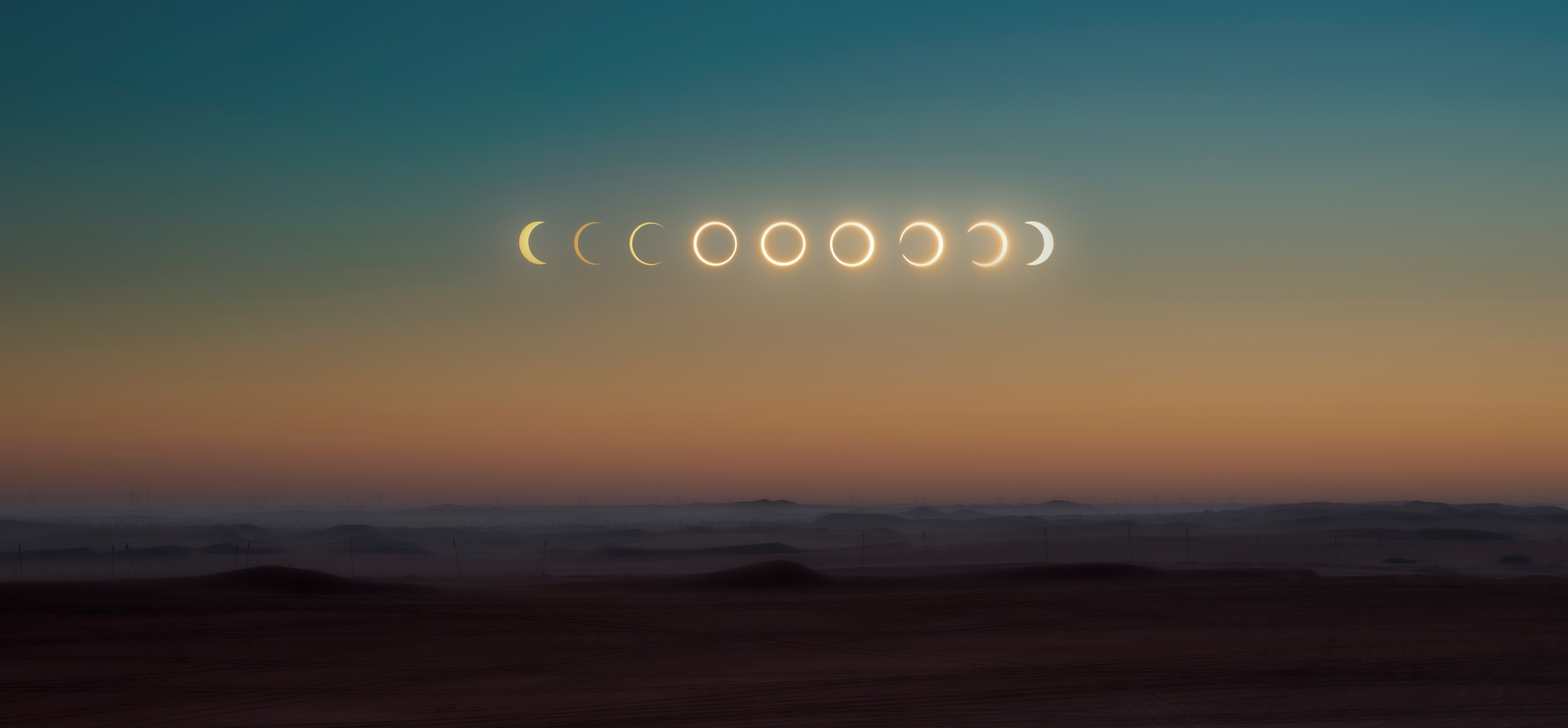
A total solar eclipse occurs when the Moon passes directly between the Earth and the Sun, its apparent diameter large enough to completely cover the solar disc. On August 12, 2026, the Moon's umbral shadow will race across the Earth's surface at roughly 2,500 km/h — too fast to chase, but slow enough to stand inside for up to 2 minutes 18 seconds depending on your position along the central line.
The experience of totality is categorically different from a partial eclipse. During the partial phases — the hour before and after — the sky remains visibly bright and the effect feels underwhelming. At the moment of totality, everything changes. The sky darkens to a deep twilight. The horizon glows in every direction with the colours of a 360° sunset. The temperature drops perceptibly. Planets and bright stars become visible. And the corona — the Sun's outer atmosphere, invisible at any other time — emerges as a white halo of structured light around the black disc of the Moon.
The magnitude of this eclipse is 1.0386, meaning the Moon's apparent diameter is approximately 3.86% larger than the Sun's — enough to produce a clear corona exposure during totality. The eclipse belongs to Saros series 126, a long sequence of eclipses repeating every 18 years and 11 days.